


Picture it. Summer in Rome. Late afternoon.
Americans, we’ve all been there.
Famished and faint after traversing the city center on foot, getting lost and unlost too many times to count, we drag our aching legs to the door of a charming trattoria.
Mouths watering, a level-ten carbonara craving raging, we can almost feel the relief of our sweaty thighs stuck to the empty rattan chairs on the restaurant patio.
We approach to find the door locked and the lights dimmed. A sign on the door heralds the bad news.
With few exceptions, most sit-down restaurants still close after lunch, which, depending on where you are, means sometime between 3 and 7:30PM.
Hot Tip: if you see the phrase orario continuato, they’re open all day.
Another option is to head for a high-end hotel bar. They’re used to accommodating at all hours.
In an emergency, most bars will serve you a pre-made panino all day.
Some spots roll out a full buffet (tavola calda) at lunchtime. After 3pm you’ll get the dregs. Think of it as the hot food buffet at a NYC bodega, but fresher and safer.
Other options include: fast food, pizza all’taglio (by the slice), and something called an rosticceria, where they serve rotisserie chicken and a lot of sides.
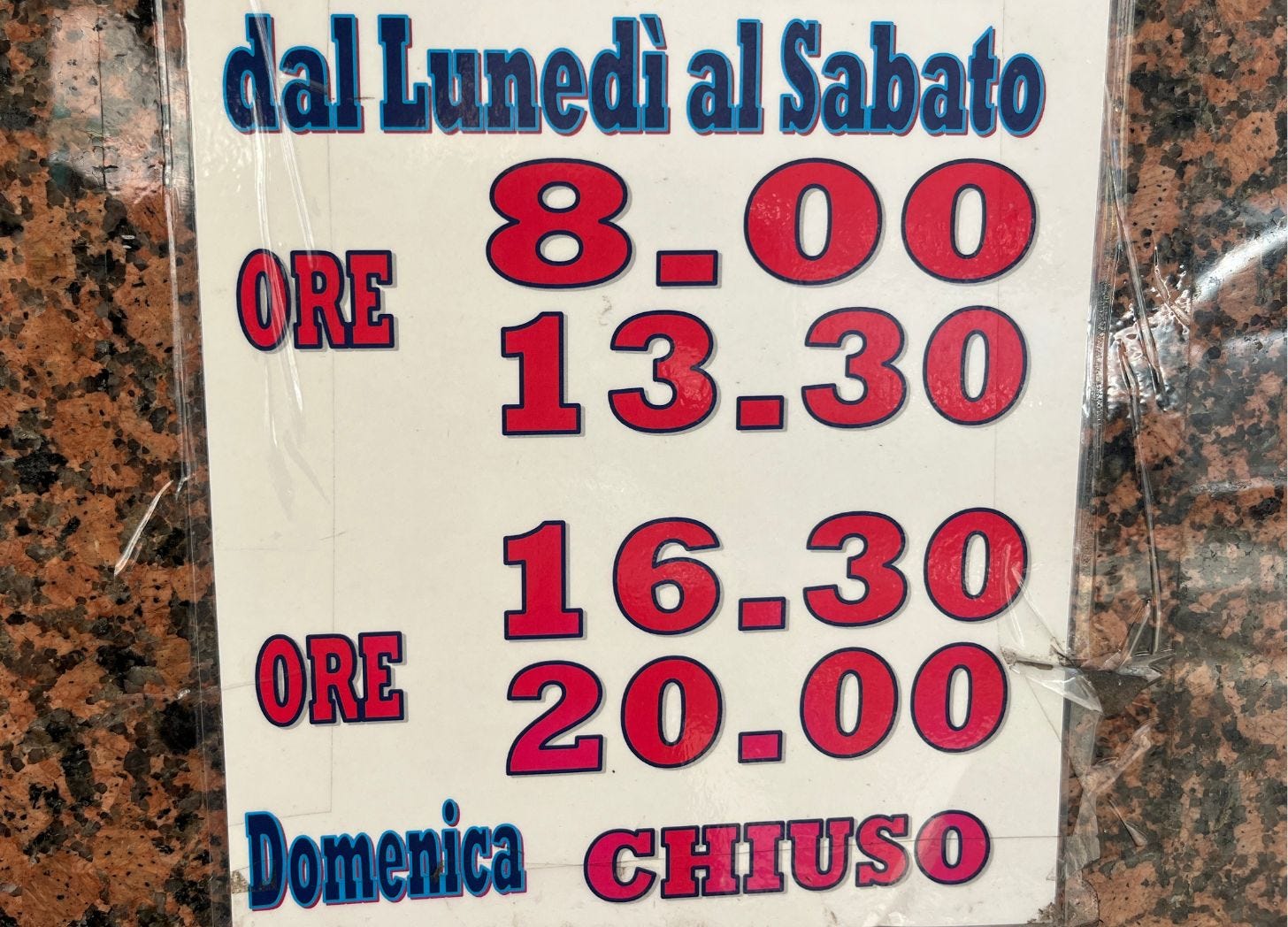
Real restaurants take a siesta, just like a plenty of stores.
If you’re lucky, they post their hours, so brush up on your military time.
It used to drive me crazy, especially when people came to visit, expected to eat at all hours, and then scorned the humble panino I’d managed to procure for them, or the subpar pasta at the only place serving spaghetti at 4pm (16).
When, What, Why, and How We Eat
When it comes to eating, Italians don’t always agree on the vocabulary or even what the rules are, just that they exist. They change by region, and even among families.
This piece is part of ongoing series. No better place to start than breakfast.
The modern Italian word for breakfast, colazione, stems from the Latin, collàtio (collection, or harvest), a derivative of collàtum: the putting together of things (or people).
Makes perfect sense to me.
You wake up. Splash some cold water on your face.
Pour a cup coffee (or as Dolly sings, “a cup of ambition”), and pull yourself together.
The word came into use among medieval monks, who frequently fasted, and then united to break it, not necessarily in the morning.
Colazione made it into English (collation) via Western Christianity with a similar meaning—a small meal to break or get through a fast. This would explain the natural linguistic evolution of own word, breakfast.
I could go into all the ways ‘breakfast’ became lunch in other languages.
Le petit-déjeuner precedes déjeuner. Both translate to “break the fast.”
In Italy, especially in the South, sometimes colazione also means lunch, but closer to noon. This feels right somehow. Though somewhat stereotypical, things do move more slowly the closer you get to the equator.
I ask if it’s more like brunch. It is not.
Back to Breakfast
Colazione. So there’s the first one, la prima colazione.
This is your responsibility—whatever you make for yourself in the morning to pull yourself together.
For some, that’s a big cup of warm milk with a splash of coffee and cookies. For others it’s yogurt and fruit. For others it’s a hand-rolled cigarette. You get the idea.
Then there is the second one. La seconda colazione.
I learned of it back when I worked in offices during in the early 2000s.
Around 10:30 am, packs of suit-clad men and women descend in packs to the bar downstairs. Most have coffee at the counter, and sometimes a snack.
They choose from the last of the pastries behind the glass display case, or tuck into something savory, like a tramezzino.
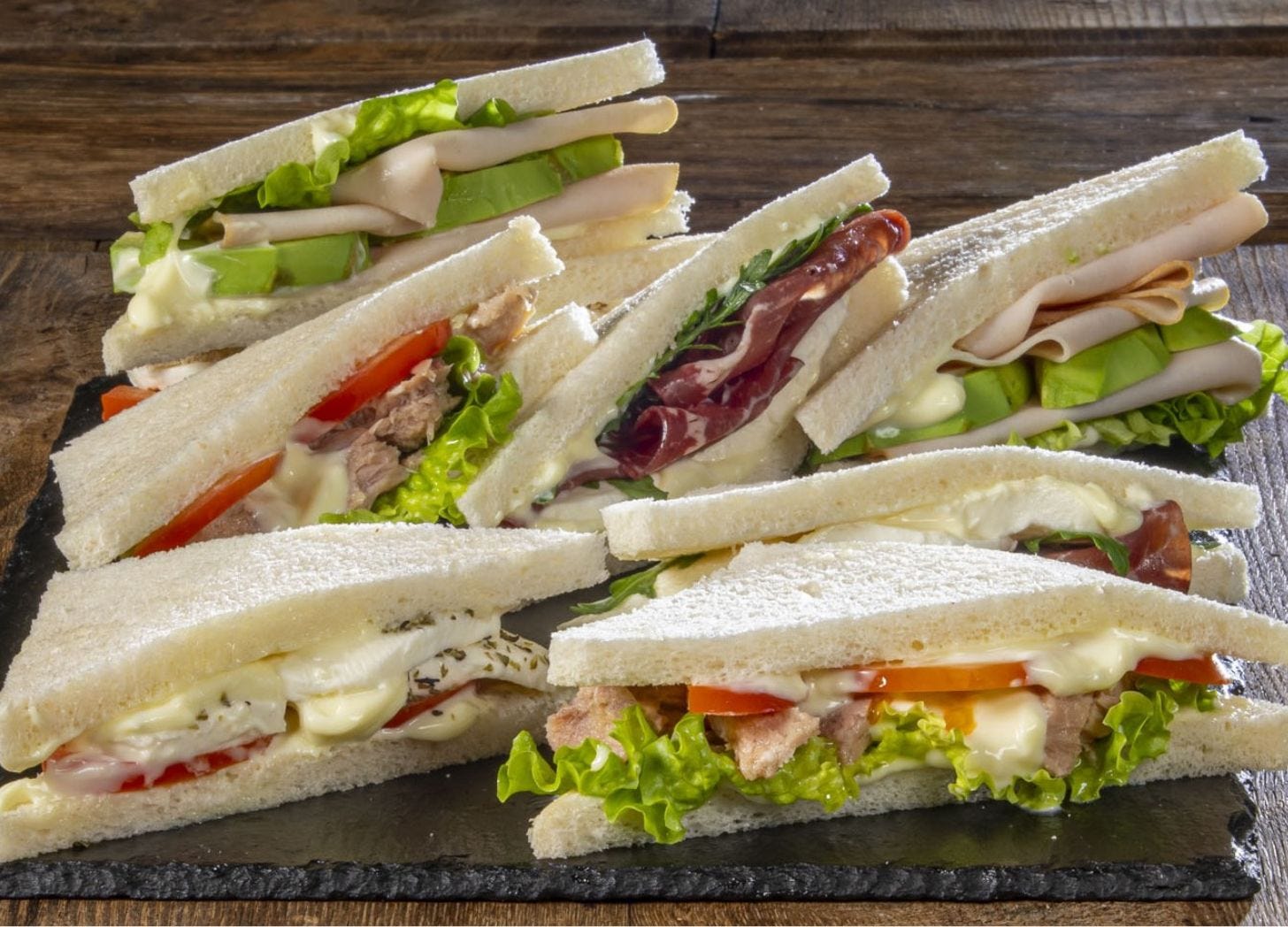
Tramezzino (singular; tramezzini, plural) comes from tra (between) + in mezzo (in the middle) + ino (a suffix makes things small).
They’re made from triangles of pillowy white bread—the kind that wads up on the roof of your mouth if you don’t swallow fast enough—and stuffed with whatever the café owner feels like.
Classics include tuna, egg, and tomato, ham and cheese, or in fancier establishments, butter and anchovies.
Tramezzini have always struck me as an adult version of a childhood junk food fantasy.
I had to grow up and move to Rome to finally satisfy the craving.
We were a strictly wholegrain household. If my mom ever cut off the crust on sliced bread, it was to make it into a shape—like a daisy (with breadcrust petals).
Tramezzini are, therefore, a private little luxury for me. A truly sinful snack.
So, second breakfast is a snack. It is, and it isn’t.
A Little Something...(Something )

For a country united around eating schedules, that prides itself on not eating fuori pasto (between them), Italian has plenty of words for snacks, including the adopted English one.
The so-called second breakfast is meant to tide you over until the next meal, which is typically lunch (pranzo).
For some people, mostly from Rome and south of it, colazione is just another way to say ‘lunch’ and it happens around noon.
So, it is lunch? Yes, but not exactly either.
When I described the mid-morning stop at the bar as seconda colazione, a few people jumped right to aperitivo. That’s old school, and I love it.
A splash of sparkling wine or a bitter-based aperitif cocktail to whet your appetite before lunch. Another little luxury.
Rules to Live By
These days I know the eating playbook of Italy, though I don’t always live by it.
Most people are shocked to learn I rarely have breakfast or lunch, but they’re relieved to hear I snack.
It took some distance to realize how much I appreciate Italians’ attention to what and when we eat. Mealtimes set the pace of the day. If someone says they’ll call dopo pranzo (after lunch), know what that means.
A pausa caffé (coffee break) only lasts five minutes, so it’s impossible not to make time for one.
I don’t need numbers on a clock to tell me (more or less) when we’re sitting down to eat.
Whenever I visit Athens, I suffer the opposite problem of hungry tourists in Rome.
I have no idea what’s coming or whether or not to save space for an amazing spread of mezze at the taverna.
Coffee takes an hour, and lunch or dinner happen anywhere between noon and midnight. It’s disorienting and I always eat too much.
It’s no surprise they invented the marathon.
Stay tuned for more on the Italian eating schedule.
We’ve barely scratched the surface. Also, I’m starving.
For more on Italy’s written and unwritten rules check out this great piece from Eric J. Lyman’s Italian Dispatch. Give him a follow if you like it!
Sorra Lella! She was before my time but she's an icon. I just wish her former restaurant on Isola Tiburina honored her memory better.
In most cases (excluding hotel restaurants) I think orario continuato is an early red flag, a sign they're after tourists and not locals.
I am sad I never went to the original IT restaurant. It's a pity. I'm still amazing when the bars roll out the buffet at lunch. It's not charming, and few travelers want any part in that, but man... sometimes it's very appetizing!