


Every era has its vices.
When it’s not the moralists, it’s the experts who exhort the virtues of sober or smoke-free living.
For nineties kids, fat was public enemy number one. Cue a collective shudder at the memory of those green boxes of fat-free Devil’s Food cookies that bristled their way down our greedy gullets. So shamelessly unsatisfied were we.
Sugar is taking a real finger-pointing at the moment. You would do well to stock your cellar with bread and pasta as the war on gluten shows no sign of subsiding.
What you may not have noticed, or have likely embraced, is the not so quiet assault on suntanning. Laying out. Sunbathing. Call it whatever you want.
Over here in Rome, prendiamo sole. We take sun. The Greeks engage in Ηλιοθεραπεία (pronounced ee-lee-o-the-ra-PEE-a). Heliotherapy. Literally sun therapy.
Somehow this most glorious and egalitarian ritual has assumed the sinister connotation of sneaking cigarettes out back. Enter the realm of bad girls who revel in self-destruction.
Picture the scene: copper-colored children naked but for white noses. They gather around a sandcastle where they squat on pin legs to reinforce the turrets carved from an overturned pail. They toil fervently and delight in the dash from each oncoming wave.
A few feet away, their mothers sprawl atop oversized towels. Their shins glisten. Every now and then they’ll cast a gaze toward the shore.
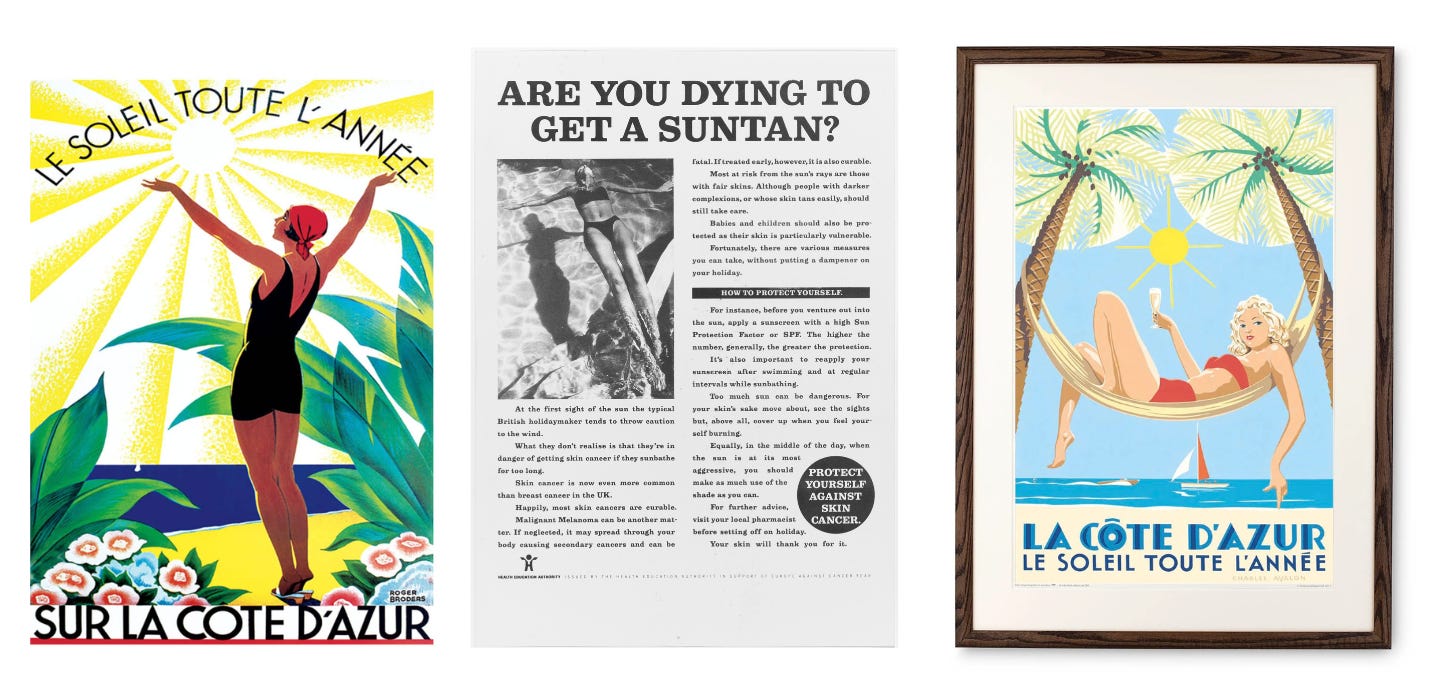
Perhaps you saw this all happening in black and white or in the faded, filtered shades of a 1970s snapshot. I spotted a vintage poster the other night, relegated to the bathroom of an uptown Manhattan bistro.
A Côte D’Azur tourism promotion proclaimed Le Soleil Toute l’Année. It featured a row of umbrellas against a glittering horizon line and a bronzed woman in white, her limbs splayed out in absolute abandon, the last vestige of a carefree and bygone era.
Ladies and gentlemen of the jury, exhibit number one is what the freckled and fair-skinned, the handwringers and naysayers envied from behind the brims of their floppy hats. I stand before you, clad only in my type-four skin, in defense of the sun.
I’m barely the first to praise and deify this life-giving sphere of light.
Since the dawn of human expression, the rising and setting of the sun has saturated archetypes and influenced language. It has inspired poets and painters and awed anyone lucky enough to catch a dusk strewn in shades of magenta or watched a golden orb slip below the horizon across a glassy stretch of ocean.
I’m here today to advocate for sun worship in its most contemporary form.
I remember my very first beach bag, a plastic-lined tote passed down to me by a friend’s older sister. It contained the liquid from condensing cans of Fresca and bottles of spilled sunscreen on the inside and kept the sand outside.
I can conjure the scent of that bag even now: creamy orange blossom and chlorine, the vague mustiness of damp bathing suits and towels abandoned overnight or longer.
Over the years, that bag would carry Seventeen Magazine, US Weekly, The New Yorker, and tattered paperback copies of The Pelican Brief or Crime and Punishment. Some people switched to the Kindle for reading, but I never did.
I cherished the sound of crinkling paper under my sweaty forearms and ink smudges across the tops of my thighs when I would read laying on my back with my knees bent and a water bottle or a rolled-up pair of jean shorts as a pillow.
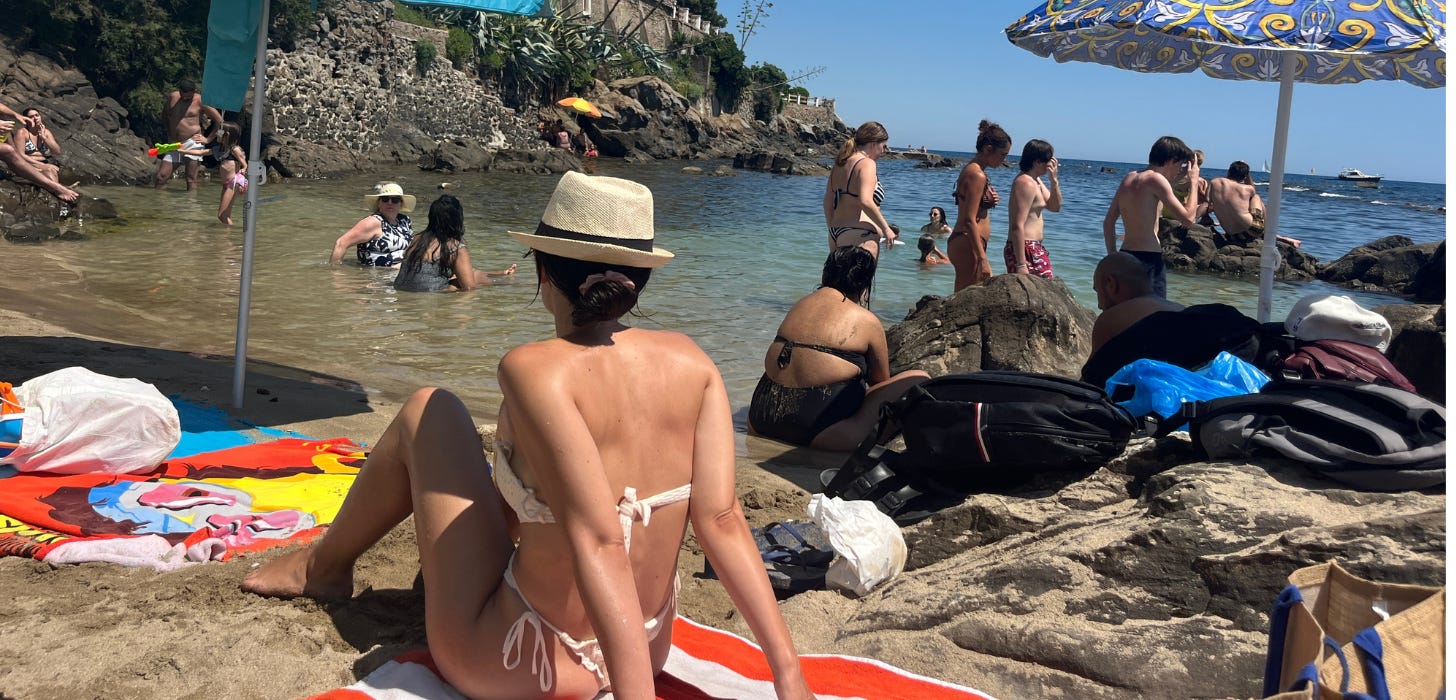
Bags in hand, we proceed with a thoughtful occupation of our patch of sand or grass or cement. We carve out cupholders in whatever the earth is made of and stretch our sarongs out wide. We secure the corners of our beach towels with our sandals to keep them from flapping and folding in the wind.
We take into account proximity to the water, the path of the sun, and of course, the view—a tranquil bay in Piñones, Puerto Rico or a throng of teenage boys at the public pool. Or maybe it’s the rooftops and steeples of Brooklyn from our own illegally paved rooftops, or the brushline of pines across a gentle bend of the Missouri River.
Throughout our lives we will come to define paradise in different ways.
Finally, we cast off our clothes and with them any last restraints. We take turns coating each other’s shoulders in SPF, careful to get under the straps of our swimsuits. We reacquaint ourselves with the feeling of the breeze on our skin.
We listen to the crescendo of an invisible chorus of cicadas, to seagull cries and the rustle of wind in the palms that almost sounds like rain, to water slapping the sides of the pool and the patter of wet feet on pavement. These inimitable summer soundtracks.
In what the Italians call il dolce far niente, we enter a state of blissful idleness. We unapologetically do nothing. Within this sacred space, we find permission to lose ourselves in trivialities. We debate for hours the power of Scorpio rising and discuss the merits of electrolyte content in tropical fruit.
Sometimes, unwrapped as we are, we tell secrets. Memories surge to the surface and sometimes it just makes sense to cry when there’s so much salt water nearby.
Under the radiant spectrum of the sun we revel in our insignificance. There is something restorative in feeling so small. For a moment we are the bronzed woman in white.
We are the sand. We are the sea. We are suddenly content to breathe and exist as part of the landscape, unhindered by thoughts of who or where we ought to be.
During this reprieve from real life, we remember what it is to live.