



Issue #14
A friend of mine recently made it out of O’Hare during a snowstorm.
That’s enough to make you believe in miracles.
There was an hour or so delay between boarding and takeoff, but according to the pilot’s announcement, they were able to make up most of the time.
Another miracle?
She recalled a quintessential Seinfeldian rant.
“So I’m on the plane. We left late. Pilot says, “We’re going to be making up some time.” Isn’t that interesting? They just make up time. That’s why you have to reset your watch when you land. Of course when they say they’re making up time, obviously, they’re increasing the speed of the aircraft. Now my question is, if you can go faster why don’t you just go as fast as you can all the time? Come on. There’s no cops up here. Nail it. Give it some gas. We’re flying!” [IMDB]
Sometimes you get lucky with a tailwind or a jet stream.
More likely, flight schedules build in the extra flight time for precisely this reason.
At the airport, no one is ever disappointed in an early landing.
Time is Flying
September always carries with it some momentum. Love it or hate it, the end-of-summer and back-to-school energy is palpable. October ought to be the month to catch our breath before November evaporates into December.
Much of the world is counting down to Christmas now, unlocking advent calendars and checking off lists. Just as many of us are watching days whir by in disbelief.
Unreached goals are about to roll over into recycled New Year’s resolutions.
How did we get here so fast?
With the exception of travel, getting older feels like a war against time. Sure, sometimes we wish we could speed up deliveries or long lines, but often we feel life slipping like sand through our fingers. These are the days of our lives.
Time Zones
You can’t talk about time without acknowledging how much of the world operates on its own notion of time, or complete lack thereof.
There’s Island time (running late), Roman time (running late), and basically any population living closer to the equator, with warm, sunny weather (running late). In southern time people even speak more slowly, melding words like melted butter.
Warm weather lends itself to lingering.
Even New York City has a 15-20 minute grace period, probably owing to the “New York minute” (a turbo reduction of a standard minute).
Time moves faster in NYC, which makes people late.
The current working theory is that wintry-weather countries move more quickly to warm up. Makes sense to me. I’ve never walked faster than on a cold, clammy night home from the bar around the corner.
Slow and Steady
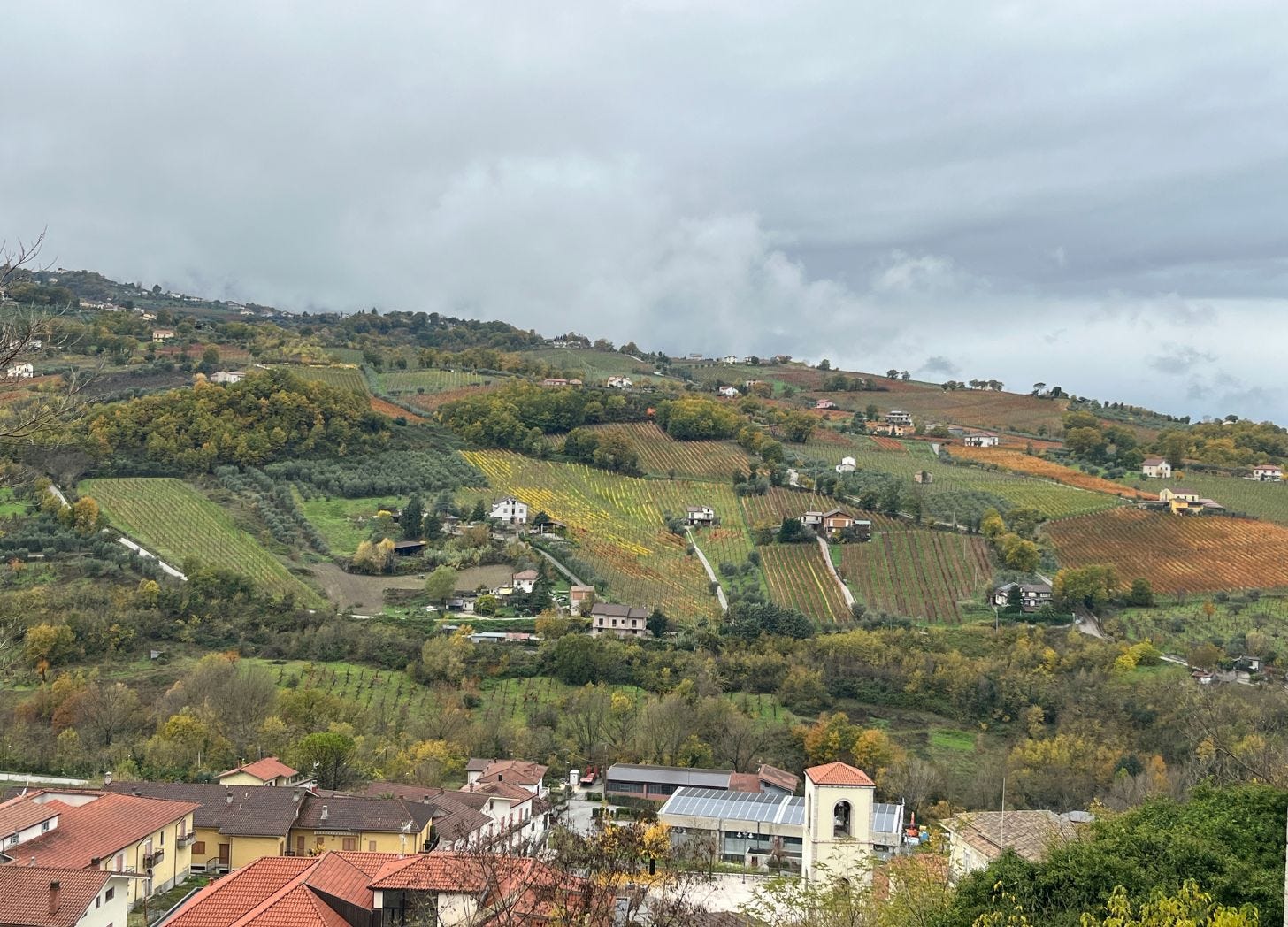
I recently visited the Taurasi growing region of Campania. Taurasi produces incredibly age-able, robust, girthy, spice-driven red wines from the Aglianico variety. The grapes thrive on mountainous vineyards, sunbaked by day and cooled by altitude and plentiful breezes at night.
It’s a slow and steady ripening that makes the difference. Perfect timing for grapes.
Between tastings we stopped for coffee in the town of Castelfranci.
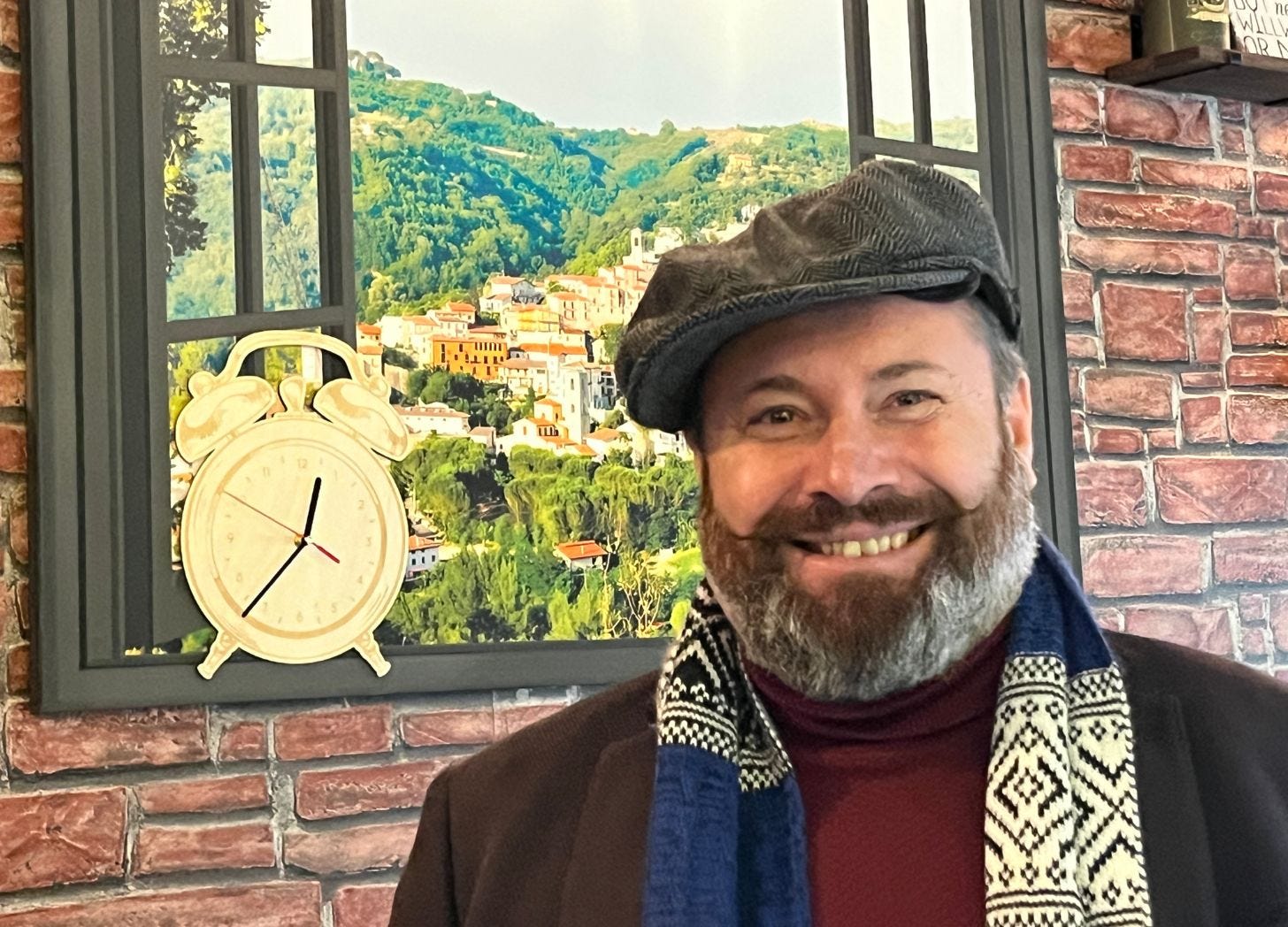
One of the wine writers in the group showed us his watch – permanently paused at 12:40. He explained that he wore the watch more as an accessory, because he didn’t really believe in any fixed sense of time. He had even coined a term for small-town rhythms.
Paesitudine. It loosely translates to “a state of small-town time.”
‘Paesi’, in this context, refers a small towns or villages. ‘Tudine’ is a suffix for state of being, like attitude, or magnitude in English.
We were an hour and a half from anything close to urban. Maybe it was the Aglianico that lulled our blood flow, or the absence of city sounds and human traffic. Even the dash to the train station failed to hasten my pulse.
If time is a construct, can’t we slow it down?
We can, actually.
Scientists have identified techniques for slowing our perception of time. Much of it has to do with cultivating a sense of wonder, breaking up our routines by taking different routes to work, and learning new skills.
When we challenge ourselves to learn a new task— a language or musical instrument, even navigating an unfamiliar path—our brains build new neuropathways.
The same theory applies to warding off dementia.
Neuroplasticity—the process by which your brain rewires itself based on what you do, think, feel, and experience—diminishes over the decades, but the good news is that we can create new pathways. We can rewire.
Are we there yet?
As children, we rarely experience the sensation of time rushing over a cliff. If anything, we stare at clocks, willing them to tick forward. We suffer interminable days at our desks in school, or in the backseat during long car rides.
So much of childhood felt like waiting. This is because so much of childhood was experiencing aspects of life for the first time. As our brains build new connections, forge memories, and encode information (like new vocabulary!), our perception of time slows down.
The more information we process in the moment, the longer the moment feels. There’s plenty of reading on the topic, but this article from Scientific American is a good start.
Can Life Abroad Keep You Young?
I moved abroad for the first time at 22. In Rome at the turn of the last century, few people spoke English. I was forced to learn fast.
Every day looked, tasted, smelled, and sounded worlds away from my Midwestern home.
Despite the lines on my face, stray greys, and near nightly four am wake-up call (for you know what), I still joke about arrested development.
I don’t feel the way I expected to, at this age.
Learning new languages still thrills me. When I’m feeling overwhelmed by to-do lists or deadlines, nothing calms me down like a Greek lesson, or a deep dive in to etymology in any language.
I have an aversion to the ordinary, you might even say an addiction to the extraordinary. I thrive on changes of scenery. Sometimes a short train ride is all it takes to soothe racing thoughts.
Dopamine chasing, maybe.
But perhaps somewhere along the way, subconsciously, I realized that if I stood still for too long, I would just die sooner.
Arrested development notwithstanding, I do feel like December came too soon. I’m reflecting on what was marvelous and memorable this year, and what we can all do to make the most of our fleeting moments.
Tastefully is my way of giving you something to make time stand a bit stiller—new words and expressions, new flavors, and hopefully, people and places that pique your curiosity, paving the way to neuroplasticity!
These are few of my favorite issues since Tastefully launched last year.

holiday


I’ll be back later this month, no rush.
Amazing read 👏🏼