


Nothing Against Pinot Grigio
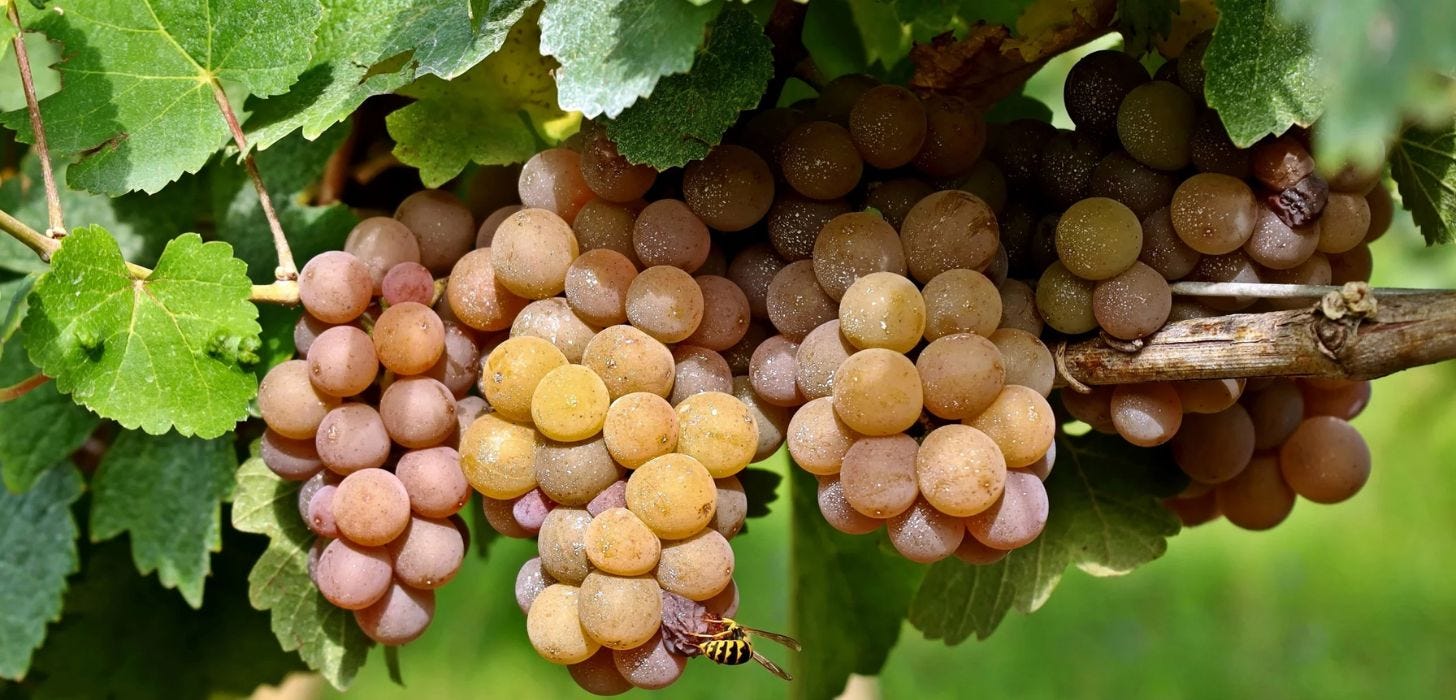
I’ve had some incredible ones, especially when they’re made in the traditional ramato style.
Ramato comes from the Italian word for copper (rame).
In wine words, grigio (grey) as opposed to bianco (white) refers to the skin of the grape.
Pinot Grigio sits somewhere between what we would call a red and white grape. some skin contact. When pressed a little skin contact, even for an hour or two, wines comes out with a gorgeous coppery rose hue.
Il Mondo è Bello Perché è Vario
Italian for “Variety is the spice of life.”
This expression can also be used sarcastically, if still affectionately, for example—some harmless weirdo you and your friends observe while sitting at a café. You shrug, maybe laugh, but ultimately don’t judge.
Generally speaking, it means that the world is a beautiful place because it is so diverse.
Italy is home to around 500 registered, certified, indigenous grape varieties.
Of those, there are hundreds of regional synonyms and local clones.
That might seem overwhelming, but why? Take your time and find your favorites.
Once you’ve tracked down a Pinot Grigio that stands out from the crowd, check out some of my favorite Italian whites.
Arneis
You’ve heard of big reds from Piemonte, like Barolo, Barbaresco, and Barbera. You may also know Moscato d’Asti, the aromatic and often unfairly maligned white wine from the same region.
Arneis, like many grape varieties, is a reference to its characteristics.
In this case: difficult to cultivate, temperamental, and tough, or strong-willed in Piemontese dialect.
There are other working theories on the etymology of the grape names, including Arnese, which is more of an industrial term for ‘an instrument necessary for performing a specific task or function.’ iIn this case wine.
Arneis is mostly delicate, with elegant notes of unripe apricot, green apple, and white flower petals. It’s usually lower in alcohol, but beautifully balanced and round.
A pleasure on the palate.
Greco di Tufo
If mouthwatering minerality is your thing, put Greco di Tufo at the top of your list.
Wines made from this grape variety, especially Greco di Tufo DOCG, finish with an explosive and addictive volcanic minerality. But they begin with pretty fruit notes like white peach and not-quite ripe apricot.
READ MORE

Vermentino
Vermentino might be the ultimate beach wine, and is absolutely perfect with oysters.
It comes in different styles from different parts of Italy, but a good place to start is Vermentino di Sardegna. Even more specifically is the DOCG Vermentini di Gallura.
Vermentino is the signature white from the isle of Sardegna, but also flourishes in Tuscany, Liguria, and Corsica.
It’s known for notes of bright lemon zest, yellow grapefruit, Mediterranean herbs, and briny sea breeze.
Catarratto
Another fun name, Catarratto sounds a lot like the eye condition, cataract.
That’s likely a misnomer, though the grape is known for the luminous coating on its skin.
Catarratto, like another great Sicilian white, Carricante, has a root word meaning abundant or fully loaded. Both varieties were cultivated for bulk wine and Marsala for years.
They’re both coming into their own lately.
Carricante is the dominant grape for Etna Bianco, whereas Catarratto has a broad presence throughout Sicily.
It’s known for its sun-ripened citrus, apple, and wild herb aromas (oregano and mint). Naturally balanced and smooth, this wine thrives on volcanic and sandy seaside soils, and picks up loads of those pretty, stony notes on the palate as well.
Famoso
Just when I thought I’d tasted every version of Italian white wine, this grape came out of nowhere and stopped me in my tracks.
Also known as Uva Rambela, it appears to be completely indigenous the region of Romagna (as in Emilia-Romagna).
While not considered a classically aromatic variety like Moscato or Gewürztraminer, Famoso may have earned its name for its instantly impactful blast of aromas.
Think: tropical fruit like mango, pineapple, and citrus, opulent florals like orange blossom and jasmine, fresh sage and even pine needles and mint.
It’s fabulously perfume-y, but on the palate is searing and dry, with a truly endless mouthwatering finish.
Malvasia
If you were a wine, what would you be?
I refuse to play unless we break it down in to red and white.
My white of choice, ride or die, is Malvasia.
My red is Sangiovese. Much of my early adult years were informed by Chianti Classico. More on that another day.
For a taste: watch our finalist entry to the 2022 Wine Spectator Video Contest
Malvasia most likely arrived with the Greeks. For the purest and most ancient expression of the variety, try Malvasia from the Aeolian Islands in Sicily, mainly Salina.
Caravaglio, a producer I used to sell in NYC, makes everything from clean and direct versions, to sumptuous, aged and skin-contact ones.
Eolia, a more recent winery I’ve come to know and love, makes exquisite elegant ones.
Malvasia is also a signature white variety in Lazio, the region surrounding Rome. There’s even a local clone, Malvasia Puntinata AKA Malvasia del Lazio.
It’s known for rich, ripe apricot and peach aromas, pink rose, and velvety white flower petals, almost always balanced with intense salinity and a pleasant sea-salty finish.
Verdicchio
The root of this one is verde (green). Verdicchio is known for its stiff, fresh, and bright qualities. Verdicchio has what we call ‘tension,’ it reverberates on the palate, which also makes it a wonderful food-pairing wine.
A glass of Verdicchio will absolutely cleanse your palate.
Thanks to its stealth acidity, it also ages well. The tight citrus notes meld into beautiful botanical herbal notes with time.
It’s mostly found in the Marche region, most famously in two growing areas: Castelli di Jesi and Matelica (look for those designations on the bottle).
Ribolla Gialla
Ribolla Gialla shows up in northeast Italy, in Friuli-Venezia, and on the border of Slovenia (where it also thrives).
Gialla means ‘yellow.’
Like Moscato—which technically comes in bianco, rosa, gialla, and nera—the colors represent visual and aromatic characteristics of the grape.
Gialla is the most pervasive variety, but nera, verde, and bianca did (or do) at one time exist.
Ribolla is one of the most ancient, early documented varieties in Italy. Its name is thought to be a derivative of ribollire/ bollire —stemming from the root ‘to boil up’—undoubtedly for the wine’s energy and vibrance.
Depending on how its made, Ribolla Gialla can lean on the fruity-green citrus side, but its main event is acidity and steely minerality. Water-washed stones and zing.
This wine historically in skin-contact versions. They come out amber-bronze in color with earthy, cider-like notes of hay and dried flowers.
For the most intense and artfully crafted versions, look for Collio, Colli Orientali del Friuli, and Brda Slovena on the label.
Glera (Prosecco)
I could have chosen from hundred of others, but I wanted to wrap this up with Glera.
Just in case you didn’t know, Glera is the Prosecco grape.
Indigenous to Veneto and Friuli-Venezia Giulia, it features in one of Italy’s most successful exports, and happily fills glasses here at home.
Look for aromas of apple and pear, wispy white florals like camomile, linden and Bradford Pear blossom, and subtle citrus.
While it’s rare but possible to find it in still versions, it expresses itself most prosaically in everyday, easy-to-drink bubbly.