


Luca Boccoli’s eyes are smiling
And so is he, a despite terrifying accident that left him instantly and incurably blind.
His skin is shockingly smooth for a Mediterranean man born in 1970, who enjoys more than the daily recommended glass or two of wine and smokes socially.
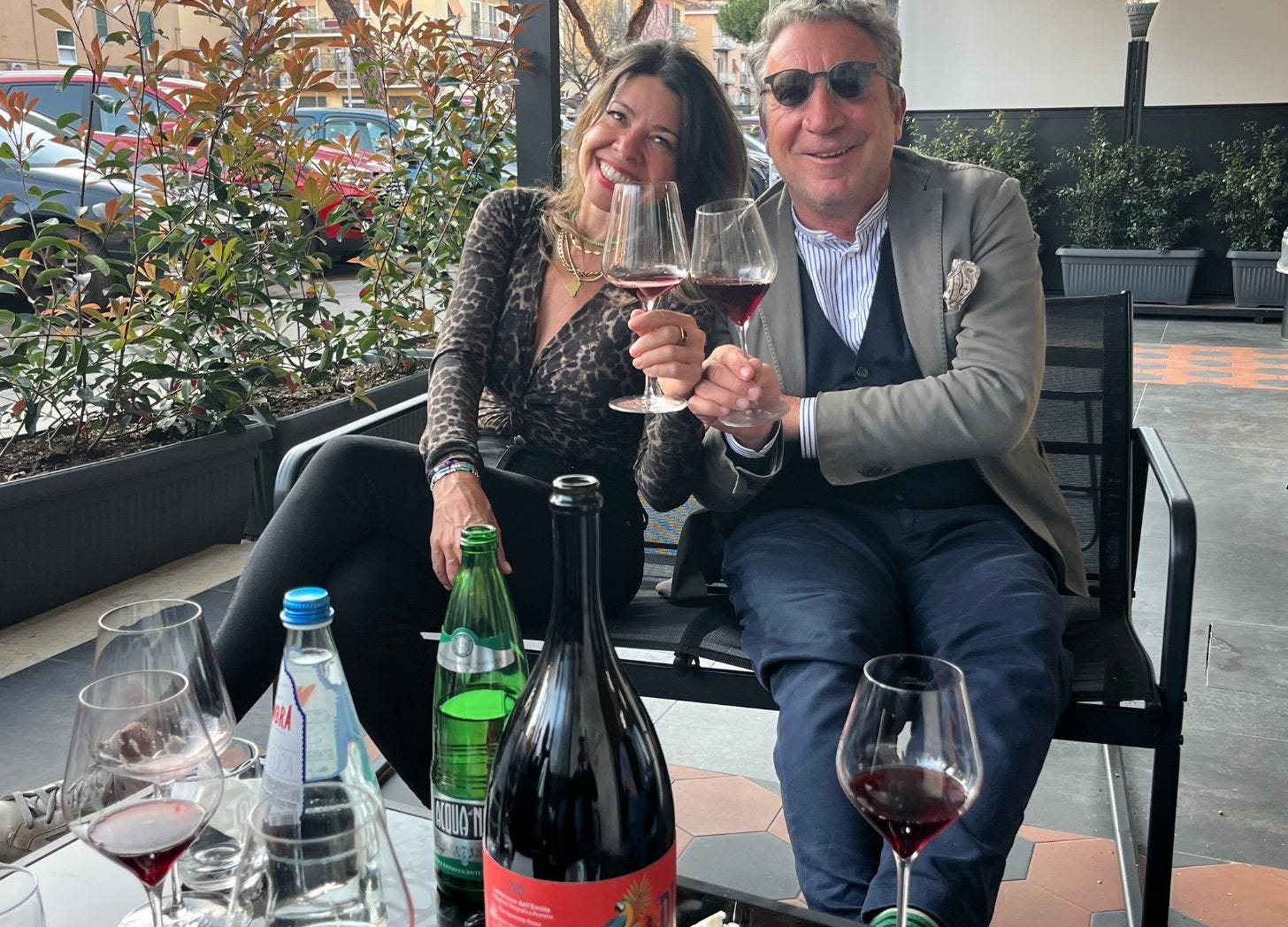
From the looks of it, he and his merry band of brothers have been at it for hours. Empty bottles and mostly empty glasses litter the table. Only the ashtrays are full.
They’re seated on the patio of Luca’s latest venture, 100C Vino e Pesce, a cheerful trattoria with a seafood menu designed to pair with his extensive wine selection.
Laughter ripples across the courtyard. It swells into a chorus of exclamations, drowning out my first attempt to alert Luca that I’m here.
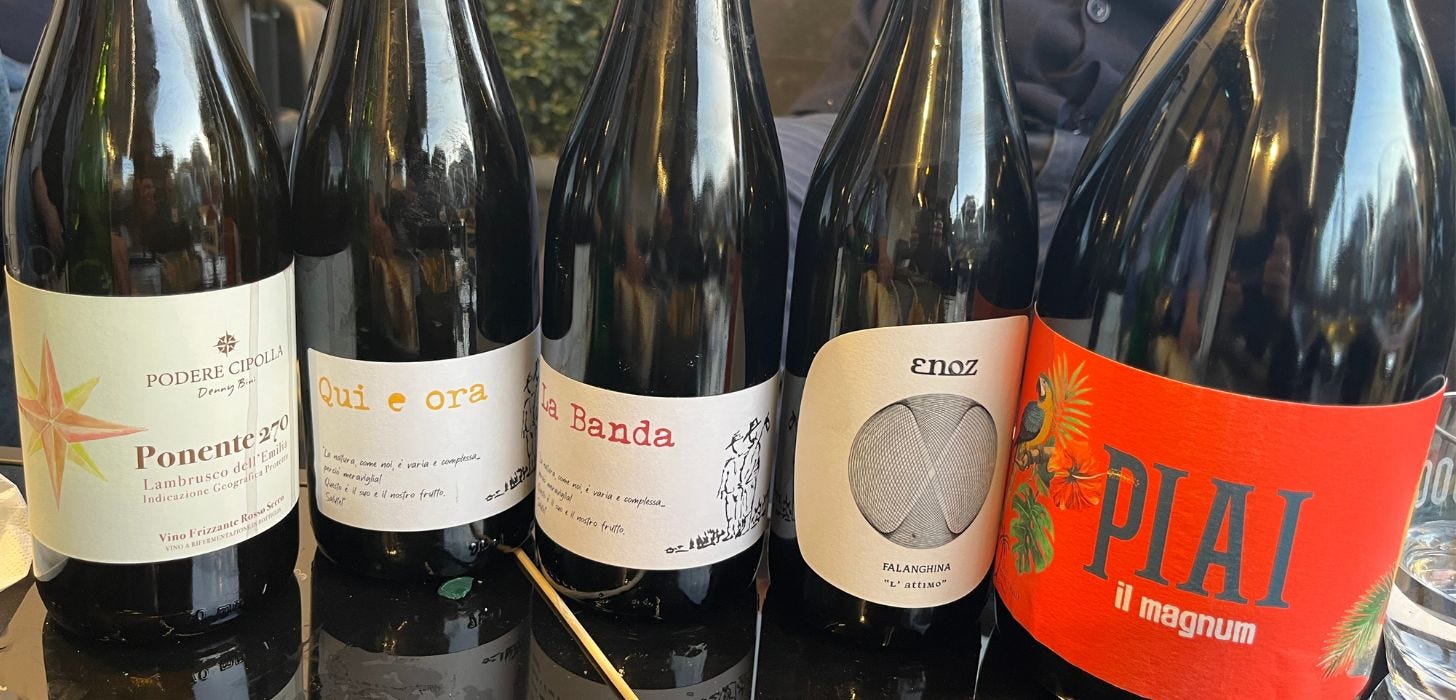
When I get close enough to tap him on the shoulder, I notice he’s balancing a magnum of Lambrusco atop his thighs while working open the cap, which explains the excitement.
Luca gestures for me to join them. He calls out to bring another glass and another chair.
They widen their semicircle and fight over who will sit next to me, erasing any suggestion that’ve disturbed a sacred space.
It’s Easter weekend in Rome, and for the first time in recent memory, it hasn’t rained.
Easter is notoriously rainy here, especially on Easter Monday, Pasquetta, a day dedicated to picnicking, which has been systematically ruined for as long as anyone can remember, the one exception being 2020, when the entire nation was trapped inside on strict Covid lockdown.
Luca opened 100C in the neighborhood where he grew up, Centocelle. His childhood best friends come every weekend. Easter is no exception.
Historically populist and rigorously working class if at one time a little rough around the edges, Centocelle encapsulates the Roman quartiere—the village-like neighborhood-y quality that is still a defining characteristic of the city, if you live here long enough to notice it.
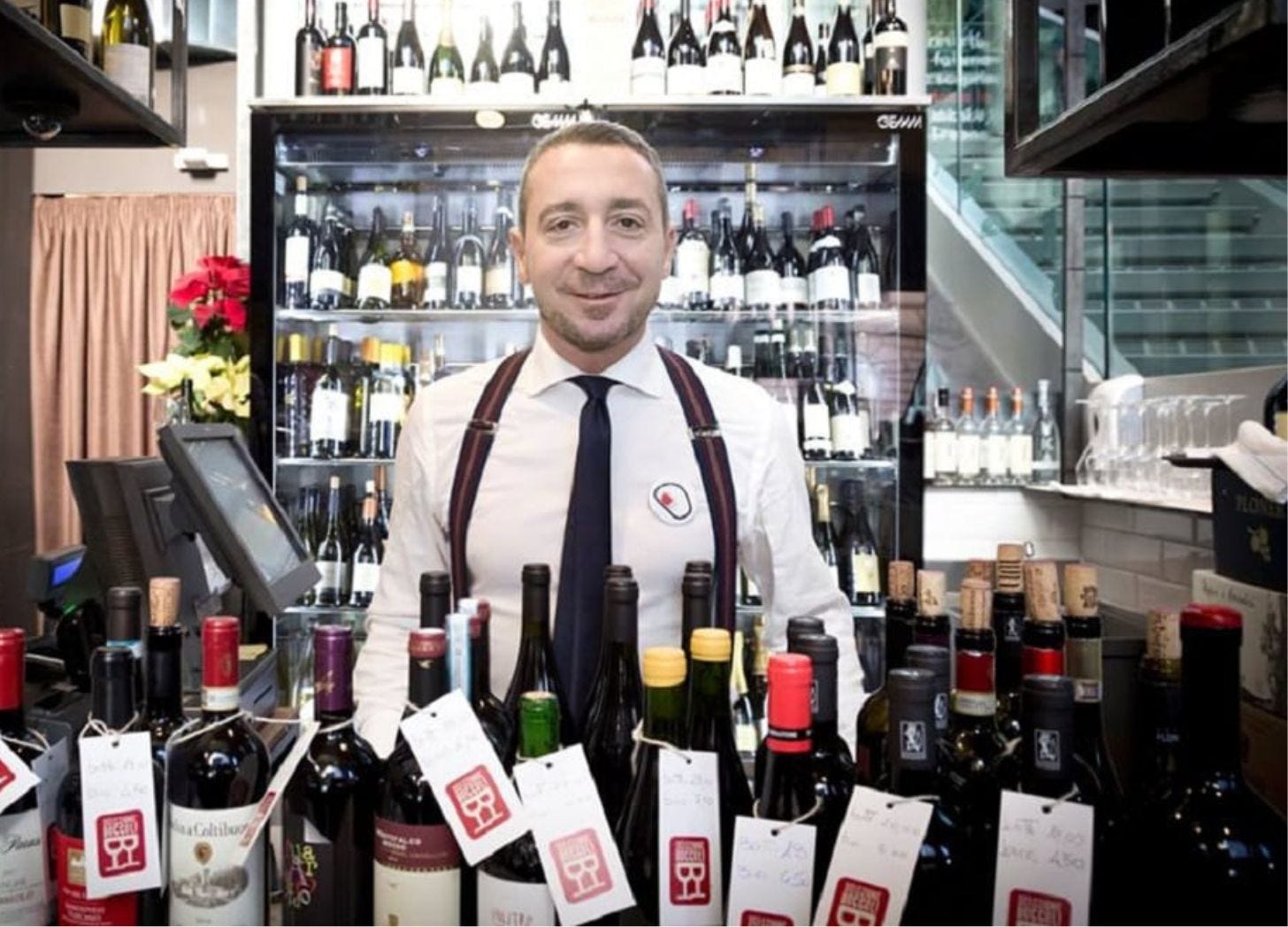
After thirty years in the wine business, as a distinguished sommelier and wine educator throughout Italy and Europe, Luca chose to open his latest spot where he grew up.
It’s part homage to his roots, and part out of ease. He’s walked these streets for years. Home is home.
Luca knows his way around.
He navigates the space of his restaurant with the confidence of a seasoned professional. There’s a choreography to wine service, and Luca doesn’t miss a step.
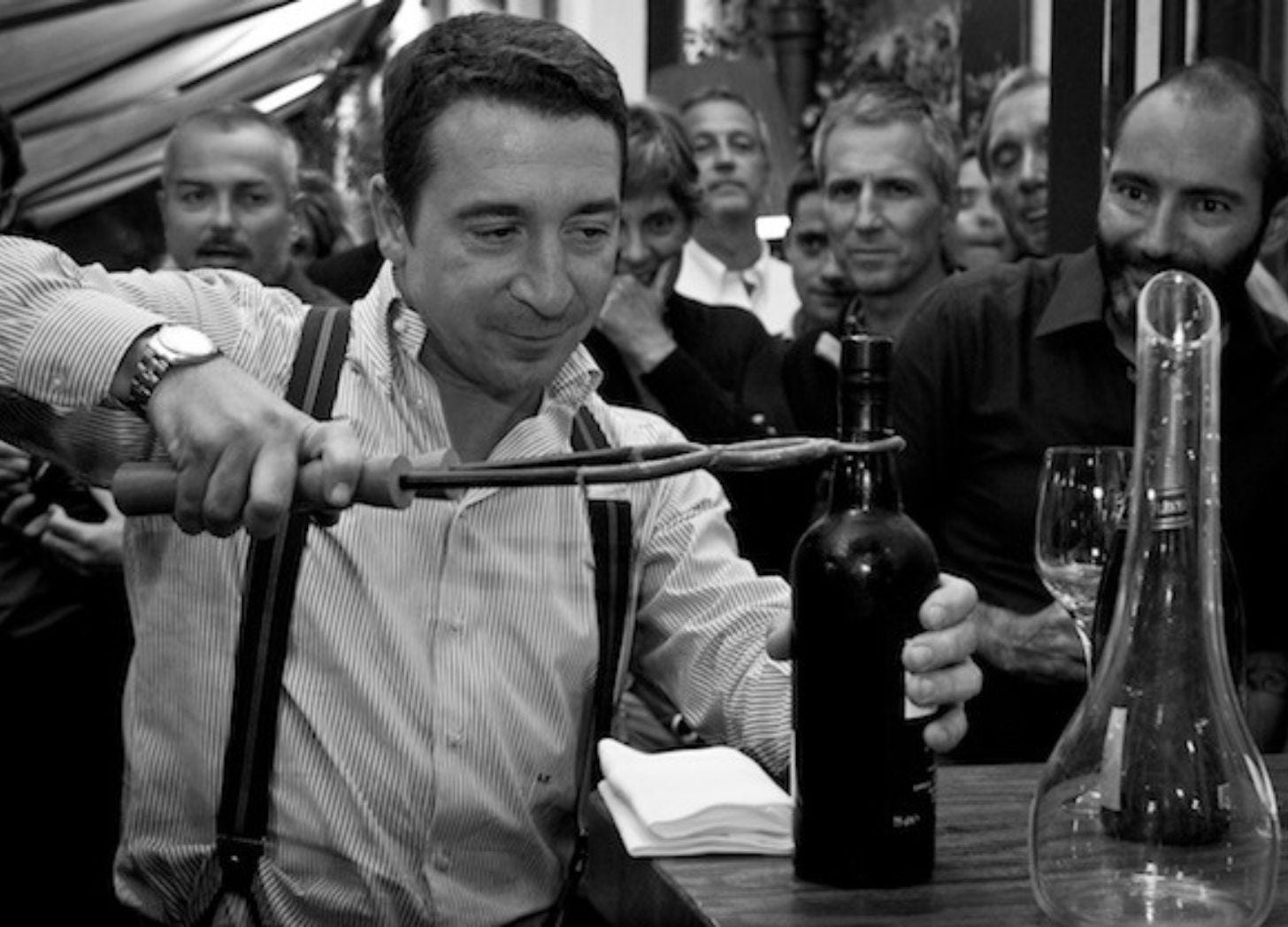
He acquaints himself nightly with the wines by the glass. He opens bottles and pours glasses more elegantly than most.
After hotel management school, Luca took the traditional first steps—seasonal work at hotel bars: in Rome, on the Adriatic Riviera Romagnola, Piemonte, and London.
At Rome’s five-star Hotel Hassler, he served guests at the bar. “The cuisine was incredible, but their wine options were limited. It was a pity! That’s when I realized wine could be a part of my career,” he says.
He enrolled at The Italian Sommelier Association (AIS), and the love affair blossomed.
The more he learned, the more he wanted to know.
In 2001, he took a job curating the wine list at Casa Bleve, one of the few upscale restaurants in Rome, equally lauded for its wine list.
Over seven years, he accompanied the owner, Anacleto Bleve, on buying trips around Europe.
“I didn’t make much money, but he took me to all the hot spots.” Luca’s eyes glow as he rattles them off: “Champagne, Burgundy, Bordeaux, Alsace, Mosel. Back then, there was none of that in Rome!”
Anacleto impressed upon him the concept of ‘wine selection,’ how to discern between high-quality wines. “Maybe you fall in love with the winery, or the winemaker, or even the place.”
In France, Luca discovered artisan winemakers, tiny producers, and true farmers who focus equal parts—if not more so—on the vineyards than in the cellar.
He sought them out in Italy too.
“In Italy, for a long time it was just huge aristocratic families making wine. With these smaller guys, you could go hang out with them in the evening when they came in from the fields.”
He met pioneers of what he calls, “vino vero” (honest wine), wines that start with the ground, before the first buds burst on the vines.
“Iconic names today, like Josko Gravner, Angiolino Maule, Gianfranco Soldera were producing genuine wines, they weren’t always perfect, but they tasted real.”
He continues, “This was all happening at a time when big woody, California-style was exploding everywhere. High in alcohol, and so thick, they were more like eating than drinking.”
In Burgundy, the wines were lighter and transparent, lower in alcohol. “We fought to bring more wines like them to Rome.”
In 2008, Luca moved on to Settembrini, a 1920s-era pastry shop-turned café and restaurant in the Prati neighborhood.
He packed the list with Champagne, Burgundy, Riesling, along with his selections from throughout Italy.
“We were the first in the city to serve so many by the glass.” He spreads his arms wide, as if inviting a hug. “We had a chalkboard on the wall this big!”
In 2015, he left Settembrini to open an enoteca within the Mercato Centrale, a gourmet food hall located inside Roma Termini train station.
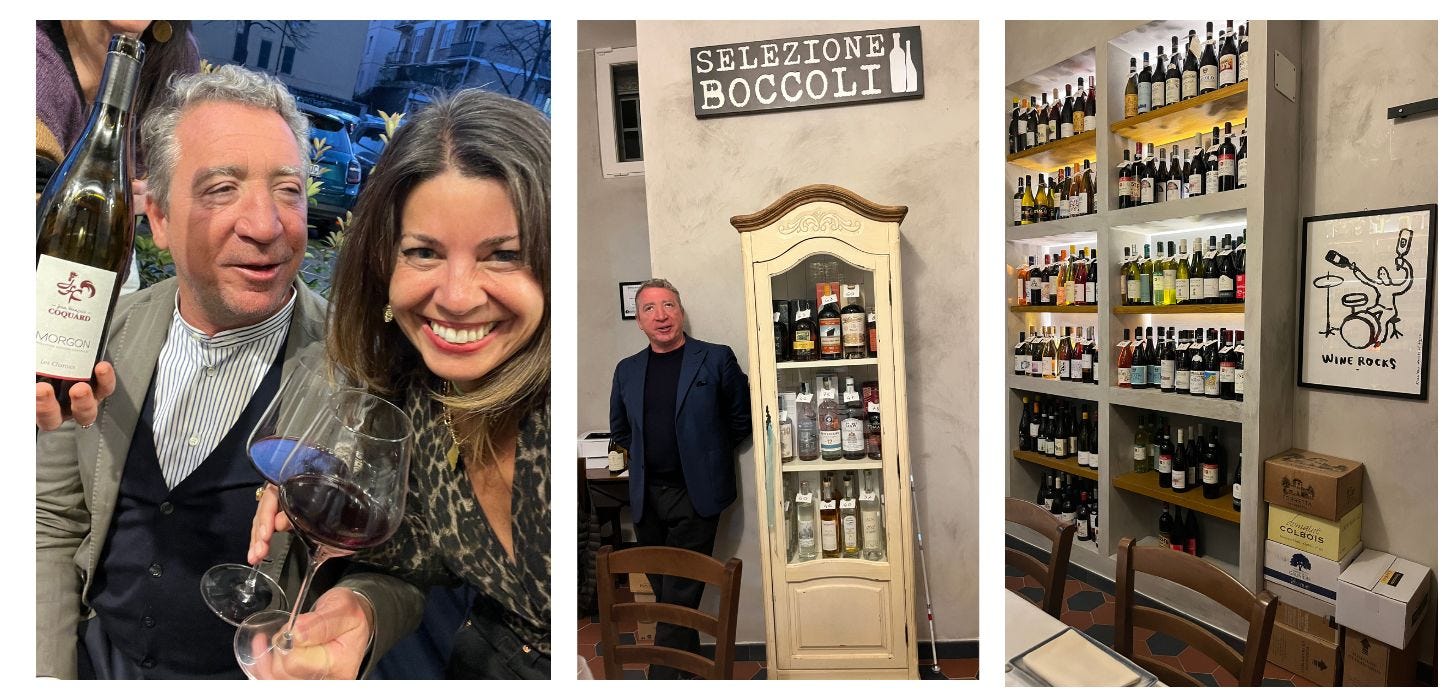
The concept revolved around Selezione Boccoli (Boccoli Selections), Luca’s handpicked bottles based on his experience and his approach to extraordinary winemaking.
Man Meets Nature: A Manifesto
As Luca explains:
Every bottle of wine is ultimately the result of man’s encounter with the land he’s working. It is the fruit of their mutual understanding—a patient, loving, and unwavering collaboration.
After years of exploration and education, Boccoli Selections features wines that represent the land where they were born, raised, and bottled by the women and men in the vineyards who cared for them.
He includes wineries that have shaped the history of wine and dynamic, dedicated producers who share his values.
During the next three years, Boccoli Selections blew up. The next steps would be to open Milan and Torino.
In October of 2018, momentum crashed to halt.
“I was about 100 meters from the Colosseum, cruising on my motorbike when the accident happened,” he recalls. It was the last time he would ever see it, or anything else.
Luca suffered a full facial fracture in the accident.
“It still hurts sometimes,” he says. “I broke every bone in my face, but somehow the rest was perfect.” He gestures below his neck and widens his eyes.
He hadn’t broken any other bones, but his body was riddled with internal hemorrhages, and he fell into a coma.
“My family was devastated. They thought I was dead.”
I did see the other side.” He muses on what may have been morphine-induced hallucinations a true brush with the afterlife. “Whatever it was, it was beautiful.”
A far less beautiful vision brought him back.
“At one point, I dreamed they were putting me in a body bag in the fridge. A doctor was telling me to wake up, to get out of there.”
That’s when his eyes opened.
On Learning He Was Blind
“The body doesn’t realize it’s blind. They kept testing me, asking me what color things were. I thought I was seeing, and all they were showing me was black.”
Luca retells these first moments with striking clarity and calm.
“So, I wake up like this and I get the news.”
He remembers standing up and wondering, “What happens now? What do I do?”
His wife Sabrina never left his side, and his two young daughters taught him to use a voiceover app on his phone. “It started as a game. We were all learning.”
Sadness spreads over his face, the first I’ve noticed since we’ve been talking. “They were as traumatized as I was. They had to learn to live with a blind person.”
He speaks candidly. “I consider myself a very lucky person,” he says.
“If you had told me 25 years ago that I would go blind, it would be agony. Always thinking about it. I had to decide to live or die. I wanted to live. So I did.”
After six months in rehabilitation, which he admits should have been two years, Luca headed to Torino for the opening of Boccoli Selections at the Central Station Market.
They had collaborations on the line, and a whole series of wine tasting events scheduled. “I couldn’t really stop,” he says, laughing.
We raise a glass to putting one foot in front of the other, no matter what.
On Blind Tasting
Wine tasting traditionally engages every sense, starting with sight.
Color, consistency, transparency, viscosity, and effervescence all play into the experience of enjoying wine.
LEARN TO TASTE WINE
When Luca lost his sight, he turned up and tuned into his other senses: scent, taste, touch, and even sound.
A perfumer and performance artist friend of his, Hilde Soliani, invited him to attend her olfactory dinners—scent experiences built around food and fragrance.
Together, they experimented with a new form of blind tasting.
“Blind tasting” refers to drinking wine without seeing the label.
A requisite exam among master sommeliers, they’re trained to identify grape varieties, distinctive wine regions, and even vintage years by looking, smelling, and tasting.
Together, Luca and Hilde experimented with blind tasting.
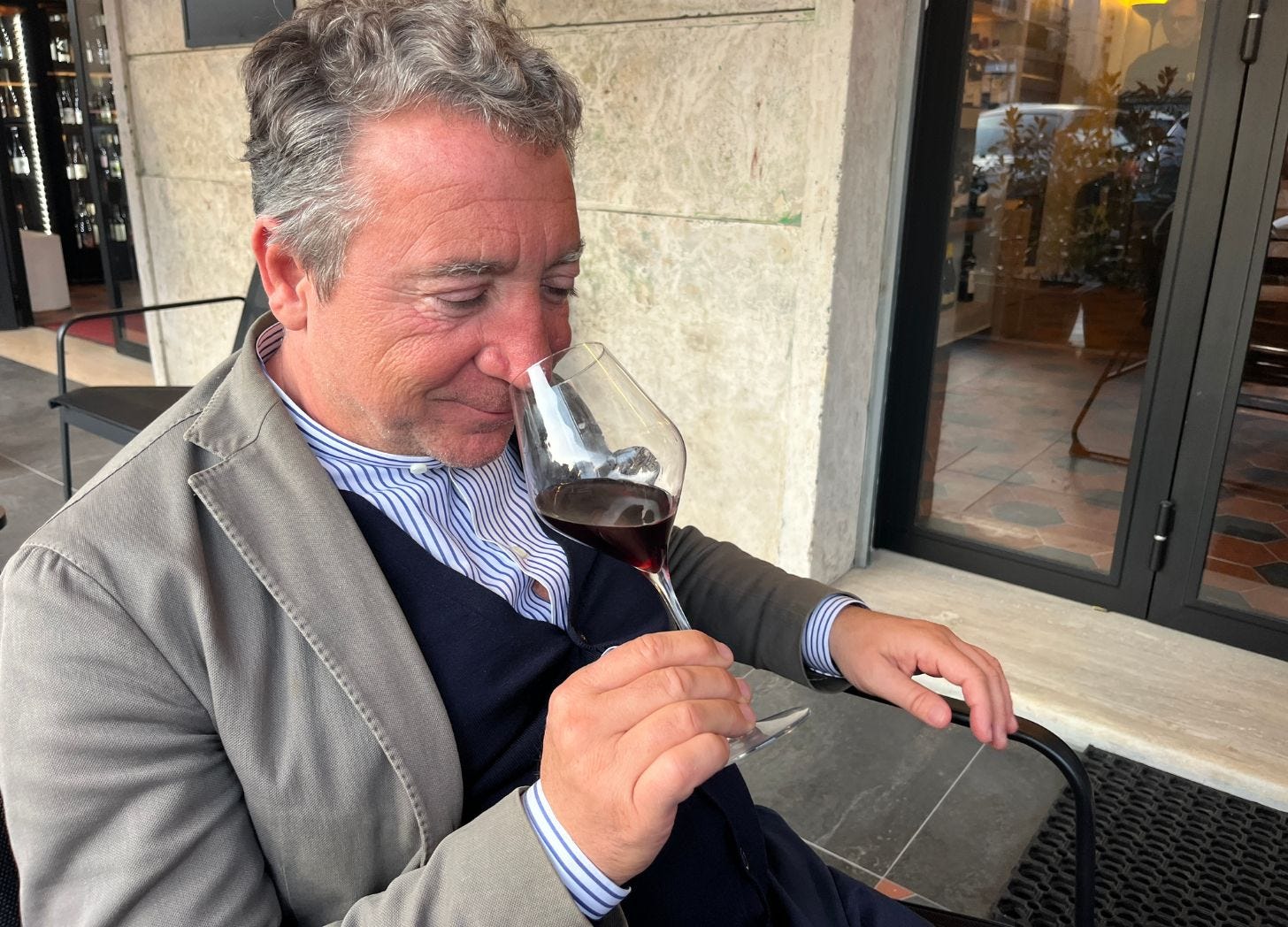
“I realized that the color of the wine stopped mattering to the sensory experience,” he tells me. “When we smell, we use a primordial part of the brain, deeply embedded with memories and emotions.”
As he talks, he pulls a bottle from an ice bath and pours two glasses. “When I remove color, I’m free to associate my memories and my impressions. That part of my memory gets unlocked.”
We both take a long sniff and a sip.
I’m the only one who can see its rich hue—a liquid gold that looks more like olive oil than white wine.
Luca continues. “Imagine someone who is blind all his life, how do you explain color? Consistency? How do you explain a blue sky? You can’t.”
I close my eyes.
It’s Marinic Ribolla Gialla, from the province of Gorizia, on the Italy-Slovenia border.
The wine is organically grown, naturally fermented and a little wild.
Luca describes it as “carnal.” I can’t disagree.
On the palate it’s vibrant, electric almost. As it warms up in our glasses, the aromas intensify.
If I hadn’t seen it I might not have the words for it, but Luca does. “It’s savory, botanical. It smells alive, like you can taste its entire life cycle.”
I’ve felt the same way about biting into mozzarella di bufala, the way you can taste the grass the cows ate.
I tell him about the first time I tasted fresh mozzarella on a farm, still warm, and served aside a sparkling wine made from grapes grown on the same property. An explosive and unforgettable combination.
As I tell it, I can hear our forks scraping ceramic, I see the faces of my coworkers and the winemaker hosting us. I remember exactly what I was swearing, and that my hair was dirty, but I didn’t care.
“When you take away sight, and all its preconceived notions, you have a more intimate relationship with the wine,” Luca says. “It’s like people. In the beginning, you don’t ask sensitive questions.”
Tasting in the Dark
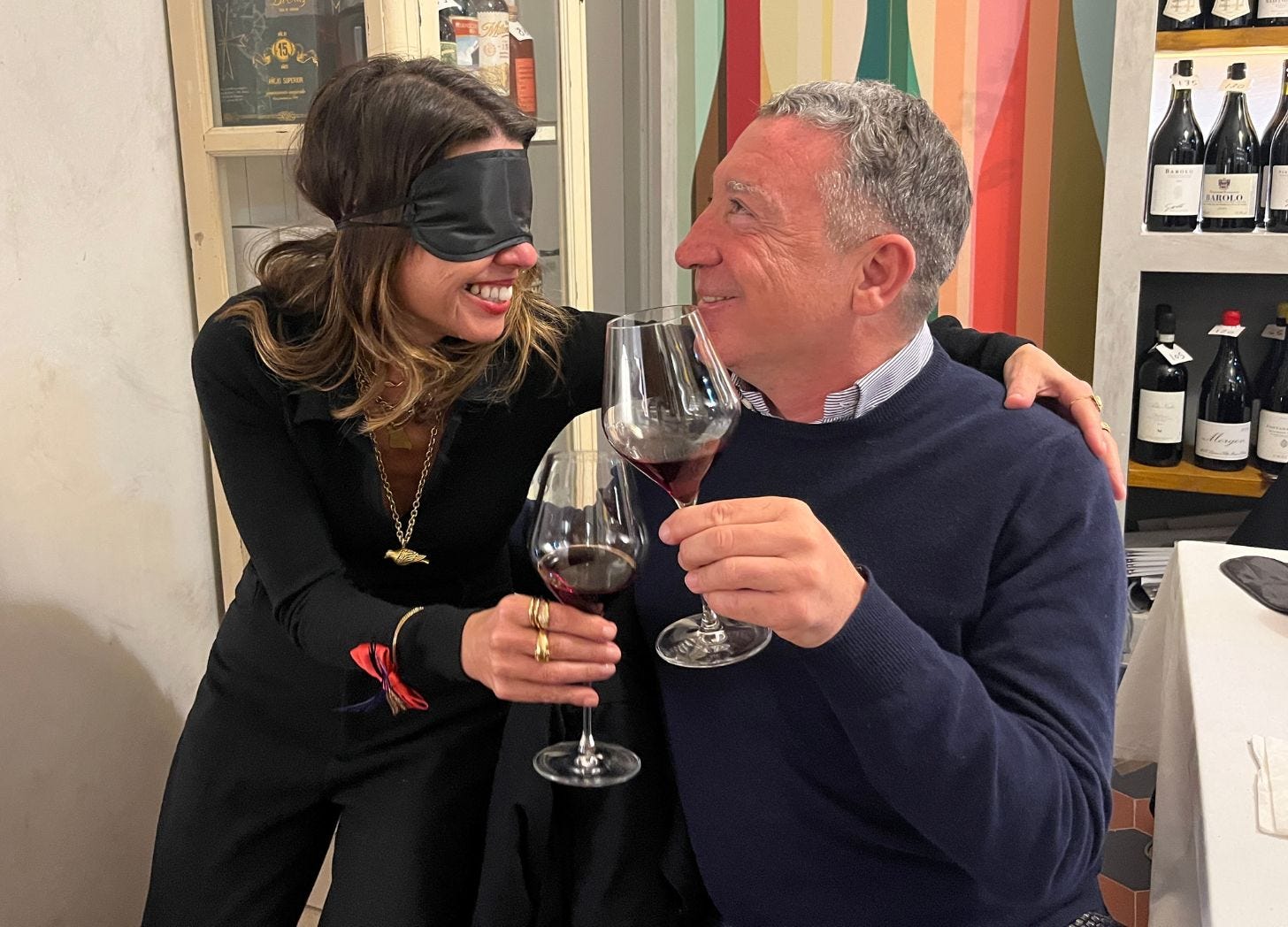
In 2019, Luca hosted the first edition of Degustazione al Buio, which translates as “tasting in the dark.”
Inspired by his experience, he invites participants to put on a blindfold and gather in dark and quiet room.
He pours the wine and plays soft music. Sometimes a coworker reads poetry. “People have trouble sitting quietly in the dark,” he tells me.
“In the beginning, I only left them a few minutes. I was afraid to leave them blindfolded for too long. But after a while, they started asking for more time.”
The Degustazione al Buio has since evolved, and Luca is taking the show on the road-to major cities in Italy, with plans to visit London and maybe even New York.
You can expect to taste in silence for around twenty minutes, followed by up to an hour of conversation about the wine—what you tase, smell, l and remember—while still blindfolded.
When the lights come up and the blindfolds come off, it’s shock and delight all around, but the true magic happens right before.
“In traditional tastings, people are quiet, nervous, they don’t want to speak up, “Luca says. “Blindfolded, they all talk on top of each other.”
No one can see, yet everyone feels seen.