


La cucina romana, Roman cuisine, as we know it today, has little to do with the city’s origin story.
Since its founding, Rome has absorbed the cuisines of the cultures it conquered, and forged its own brand of cucina povera—cuisine born out of scarcity.
Il quinto quarto (the fifth quarter) famously refers to the organs typically tossed by the butcher—brain, intestines, heart, and kidneys for example. They all play a role in Roman cuisine.
There are entire books written on it, including Katie Parla’s recent release - a comprehensive history and cookbook.
While flatbreads have been documented as far back as ancient times, and rice and has been around forever, pasta is a relatively modern addition to Italian cuisine, Rome included.
The Big Four
Carbonara, Gricia, Amatriciana, and Cacio e Pepe.
They all overlap with variations of cured pork cheek (guanciale), black pepper, and pecorino cheese.
You’re likely familiar with Spaghetti alla Carbonara (bacon and eggs), and even more likely familiar with cacio e pepe. The sheep cheese and black pepper pasta sauce swept the States a few years back, creating a craze and inspiring thousands of viral video content.
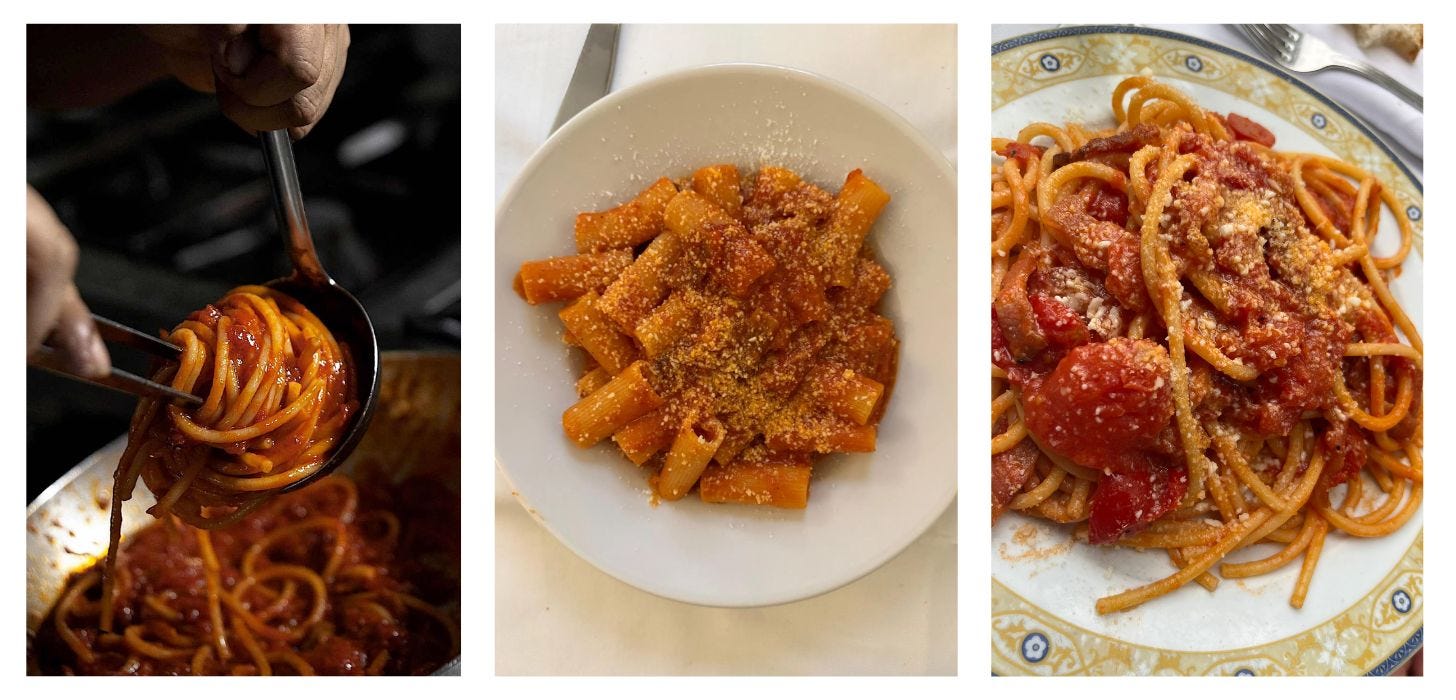
Bucatini (or insert other pasta) all’Amatriciana rarely shares the spotlight, and I’m fine with that. I’ll happily cover it here. No need for think pieces or $30 versions at trendy NYC joints, or g-d forbid another bucatini shortage!
What sets Amatriciana apart from the other three is the presence of tomatoes—another ingredient that joined Italian cuisine following the empirical conquests.
You absolutely must try Amatriciana in Rome or give it a go at home. It never disappoints. Here is everything you need to know.
Once Upon a Time in Amatrice
Amatriciana takes its name from Amatrice, a mountain town that was once part of Abruzzo, and only later annexed into Lazio, the region surrounding Rome.
Italian regional cuisine is a history lesson most of the time.
The dishes from the Apennine mountains reflect the area’s long sheep herding tradition. Cured meats and hard sheep cheeses stayed fresh during the seasonal migration from the higher altitudes to the lower lying plains.
Gricia, also known as amatriciana bianca (white Amatriciana) likely originated here too. It’s essentially the same recipe, minus the tomatoes. The nearby town of Grisciano may explain the name.
Both recipes made their way to Rome, which speaks in equal parts to history, geography, and immigration.
I can’t even count the number of people I’ve met here since 2001, who call Rome home, but still have relatives in Abruzzo.
The largest waves of immigration from Abruzzo to Rome took place in the 19th and 20th centuries. That’s given the dish plenty of time to settle into its adopted home, and even drop the A.
Matriciana is almost as common as All’Amatriciana on Rome menus today.
Anna de Angelis: Mamma Amatriciana
Local legend attributes the dish’s popularity to one woman in particular, Anna De Angelis.
Anna arrived from amatrice during the 1870s with little more than the clothes on her back. Allegedly, she set up a small space near Termini station to serve fresh pasta to the fruit and vegetable merchants who worked at the local market.
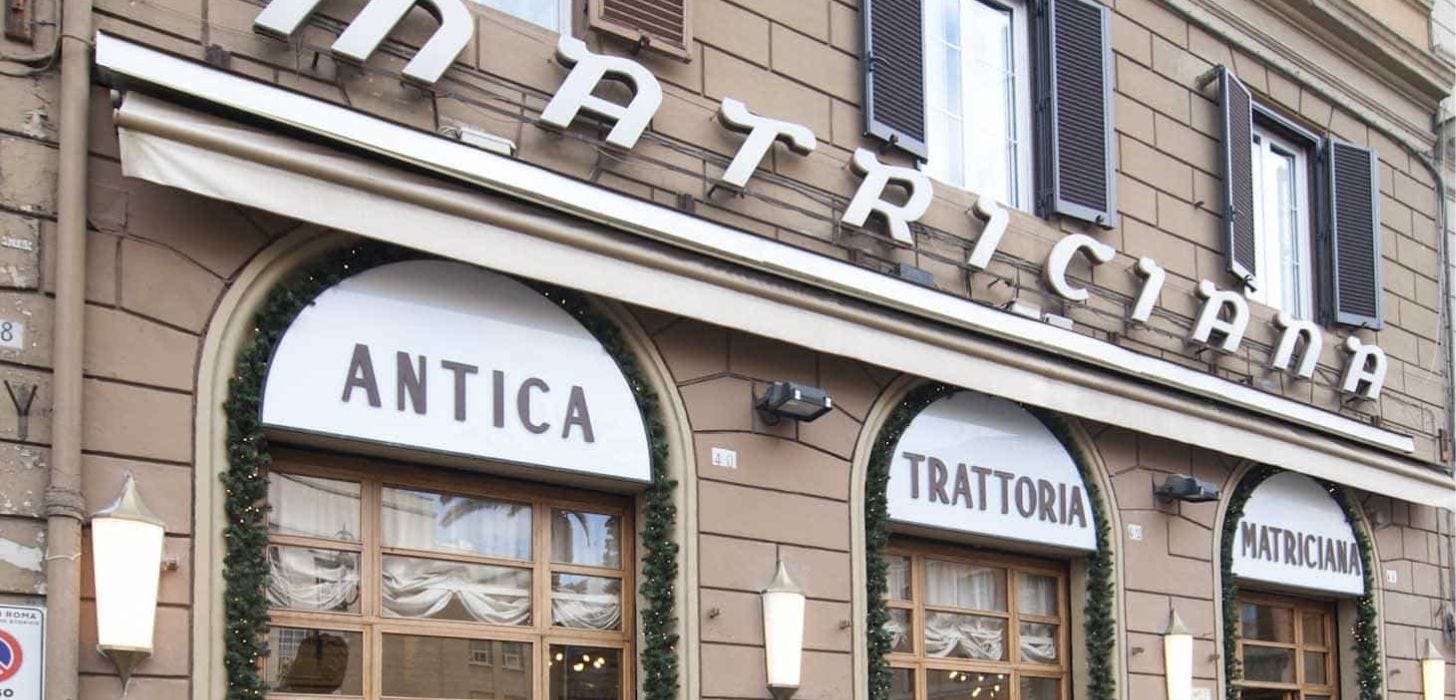
Soon enough, her stand gained traction and locals began referring to it as “La Matriciana.” The establishment gradually expanded, coinciding with the construction of the old Teatro Costanzi in 1880, now the Teatro dell’Opera.
One of my favorites restaurants in Rome now occupies the space.
La Matriciana dal 1870. They have happily adopted the story, and they make an excellent one!
The Amatriciana Recipe
The recipe begins and ends with guanciale, cured pork cheek. It’s sliced into strips or cubes and browned in its own fat.
Set the meat aside and use the same pan to make the tomato sauce. You can use canned or fresh tomatoes. The idea is to season them with the rendered guanciale fat.
Toss the pasta—bucatini, mezze maniche ( half rigatoni), and spaghetti are the most popular—and add a generous dusting of grated pecorino cheese and black pepper.
The beauty is in the balance. The freshness and acidity of the tomatoes tempers the pork fat, which allows all the rich flavors to really sing. Freshly grated black pepper and deeply earthy pecorino take it to the next level.
Check out one of my variations on this classic dish!
Smoky Amatriciana Recipe

Truth or tall tale, some of the greatest recipe origin stories involve accidents, shortages, forgotten ingredients, and the savvy chefs who improvised to save the day.
Where to eat “La Matriciana” in Rome
I took a poll and added the most popular responses to my own list. Read on for the ultimate Amatriciana hit list.
*By no means an exhaustive list. I welcome your thoughts and recommendations!
La Matriciana dal 1870
One of my favorite spots for old-school grand service—think white table linens, waiters in vests, monogrammed plates—and consistent quality, mid-range prices, and a solid local wine list.
Matricianella
Ever so slightly fancier (read pricier) than La Matriciana dal 1870, but still holds on to the family vibe since 1952. They’ve got a spectacular wine list (It’s bible bound) and a fabulous outdoor seating area.
Flavio al Velavevidetto
The name translates to “I told you so.” This place is a local legend in the Testaccio neighborhood. I heard about it first from a taxi driver, which is a guaranteed solid rec.
Flavio refers to the chef, Flavio de Maio, who worked alongside Felice Trivelloni, of the now infamous Felice a Testaccio.
The word on the street is that Felice, while delicious, attracts the tourist and influencer crowd, whereas the real ones head here. I’ve been. Approved!
Hostaria 100celle
No website, just a beloved neighborhood spot way off the beaten path in Centocelle. About a 20-minute cab from the center. Here’s the address and phone number: Via delle Acacie, 122 | TEL +39 06 2180 7805.
Osteria Palmira
Another family spot with ancestors in Amatrice, Osteria Palmira appears on multiple Top Amatriciana lists, including those of my friends’. They have two locations, in Monteverde and Prati. Both excellent.
Hostaria Nomentana
Ultra local flavor right here! This is my new spot. I recently moved into a new apartment, and this tiny restaurant barely caught my eye at first. Understated, no-frills, gruff-seeming owners… you name it. It’s got all the hallmarks of authenticity and actually lives up to the stereotype.
Incredibly fresh seafood, the classic Roman dishes, reasonable prices, and a perfect little wine list. The owners do actually smile once you give them a chance.
They make their amatriciana with whole datterino tomatoes (like me!). So succulent and juicy. Maybe I’m biased, but it might be me favorite in the city.
No website for this one either. Here’s the address and phone: Via Nomentana, 429 | TEL +39 06 8621 8185.
Trecca
They’re so cool it’s almost annoying how good the food actually is. Brothers, Manuel and Nicolò Trecastelli were inspired by the city’s vibrant produce markets and nearby food halls.
They’ve re-envisioned the old-school trattoria with emphasis on seasonal produce, careful technique, and robust, intense flavor. They’re not afraid to add a touch of onion or deglaze with wine here and there for extra punch. But the nostalgic quality is indisputable. Reservation recommended.
Il Matriciano
An institution since 1912 in the Prati area, it was founded by Amatrice native, Luigi Colasanti.
It’s now in its fourth generation of family ownership and has remained both a neighborhood staple, as well as a popular meeting place for Rome’s literati and cinema set.
If it’s good enough for Pier Paolo Pasolini, Alberto Moravia, and Elsa Morante, Roberto Benigni, and the original Latin lover, Marcello Mastroianni… it’s good enough for me.
Also, I’ve eaten there. Approved!
Sarah Cicolini (Santo Palato) and Luciano Monosilio (Luciano) are two trending chefs to watch.
Both lean strongly on the purity of their ingredients for a refined take on recipes that never lose their rustic edge.
Buon appetito!
Romans (born, raised, adopted...) I know it's coming! Drop your favorite Amatriciana in the comments. I know you have one.